
Introduction to the Casting Industry
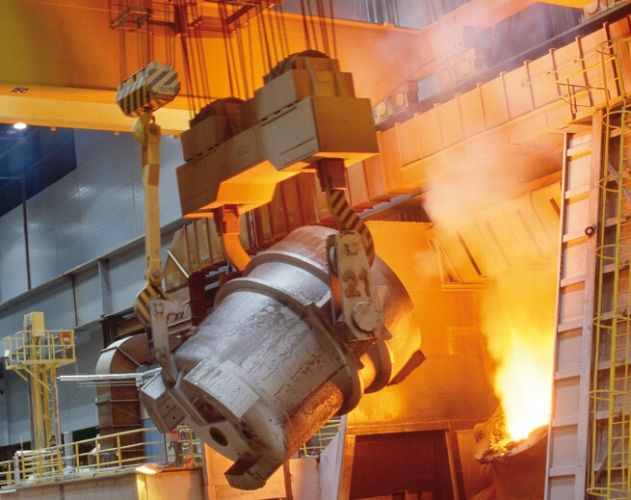
Casting is an industry with roots in traditional craftsmanship. There are many types of casting, which are conventionally classified by molding method into: ① Ordinary sand casting, comprising three categories: green sand (moist sand) casting, dry sand casting, and chemically hardened sand casting. ② Special casting, which can be further subdivided based on mold materials into processes using natural mineral sands/aggregates (such as investment casting, loam/clay mold casting, shell mold casting, negative pressure casting, full-mold casting, and ceramic mold casting) and processes using metal as the primary mold material (such as permanent mold casting, die casting, continuous casting, low-pressure casting, and centrifugal casting). Casting processes typically involve: ① Mold preparation (creating the container that transforms liquid metal into a solid casting); molds are classified by material (sand, metal, ceramic, loam/clay, graphite, etc.) and by reusability (expendable, semi-permanent, and permanent), with the quality of mold preparation being a primary factor affecting the final casting quality; ② Melting and pouring of casting metal (casting alloys), primarily involving cast iron, cast steel, and non-ferrous casting alloys; and ③ Casting treatment and inspection, which includes removing cores and surface debris, cutting off gates and risers, grinding away burrs and flash, as well as heat treatment, shaping, rust prevention, and rough machining. KEEJOO Solutions: 1. KEEJOO provides surface cleaning and coating production lines for automotive structural components.
Continuous Shot Blasting Cleaning Line Solutions for Castings — From the Expert Team at KEEJOO
I. Shot blasting line solution recommended by KEEJOO:
I. Shot blasting line solution recommended by KEEJOO:
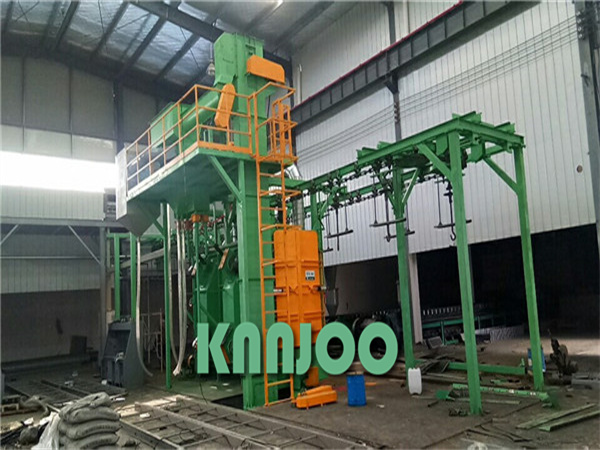
1 Overhead Rail Shot Blasting Machine
1. Model: KJ-1027P11-16 (Model selected based on product dimensions).
2. Maximum part dimensions: Length: 2800mm, Width: 400mm, Height: 1000mm.
3. Maximum part weight: 2 tons.
4. Number of blast wheels: 16.
5. Blast wheel power: 11 kW/unit.
6. Blast wheel motor: Siemens.
7. Semi-automatic flow control valves: 16 sets.
8. Operation mode: Fully automatic.
9. Machine inlet dimensions: Width: 1000mm, Height: 2800mm.
10. Conveying method: Automatic chain conveyor.
11. PLC: Siemens.
12. Touch screen: Siemens.


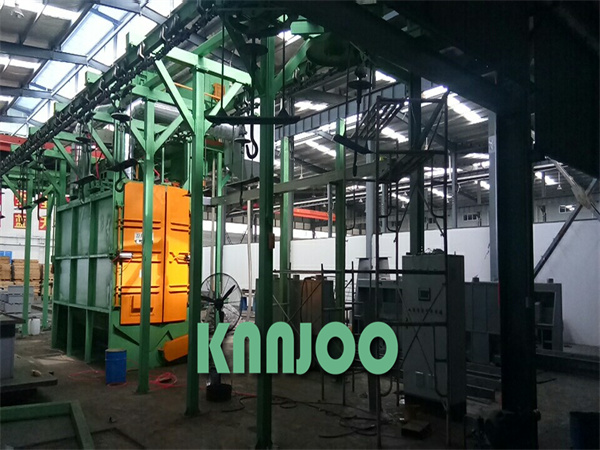
2. Hook-type Shot Blasting Machine
1. Model: HSK-1717P11-3 (model selected based on product dimensions).
2. Maximum part dimensions: Diameter: 1700 mm; Height: 1700 mm.
3. Maximum part weight: 2 tons.
4. Number of blast wheels: 3.
5. Blast wheel power: 11 kW per unit.
6. Blast wheel motor: Siemens.
7. Semi-automatic flow control valves: 3 sets.
8. Operation mode: Fully automatic.
9. Conveying mechanism: Dual-track, dual-hanger system.
10. Automatic double-opening doors.
11. PLC: Siemens.
12. Touch screen: Siemens.

3. Mesh-Belt Shot Blasting Machine
1. Model: WD1200-11-8 (Model selected based on product dimensions).
2. Maximum part dimensions: Width: 1000mm, Height: 300mm.
3. Maximum part weight: 1 ton.
4. Number of blast wheels: 8.
5. Blast wheel power: 11 kW/unit.
6. Blast wheel motor: Siemens.
7. Automatic flow control valves: 4 sets.
8. Operation mode: Fully automatic.
9. Conveying system: Mesh belt conveyor.
10. Machine inlet: Width: 1200mm, Height: 300mm.
11. PLC: Siemens.
12. Touch screen: Siemens.


4 Venturi-type dust collector
1. Model: LT-80 (Explosion-proof type).
2. Designed for use with the corresponding shot blasting machine.
3. Fan power: 22 kW.
4. Airflow: ≤9,000 m³/h.
5. Air pressure: ≤7,000 Pa.
6. Noise level: ≤80 dB.
7. Air inlet/outlet diameter: φ320 mm.
8. Dust emission: 30 mg/m³.
9. Equipped with automatic sludge scraping device; sludge scraping motor: 0.37 kW.
10. Water pump motor: 7.5 kW.
11. PLC: Siemens.
12. Touch screen: Siemens.


II. What product solutions can KEEJOO provide?
1. Sand Casting Products
1. Information to be provided by the customer:
2. Single-part length (provide both maximum and minimum lengths).
3. Single-part width (provide both maximum and minimum widths).
4. Part thickness.
5. Single-part weight (provide both maximum and minimum weights).
6. Part material.
7. Processing steps prior to shot blasting.
8. Requirements for surface cleanliness and roughness.
9. Production volume requirements (daily/monthly/annual output).
10. Requirements for the dust collector.
11. Height and spatial dimensions of the facility where the equipment will be installed.
12. Any other customer requirements.

2. Investment Casting Products
1. Information to be provided by the customer.
2. Part dimensions: length (provide both maximum and minimum).
3. Part dimensions: width (provide both maximum and minimum).
4. Part thickness.
5. Part weight (provide both maximum and minimum).
6. Part material.
7. Processing steps prior to shot blasting.
8. Requirements for surface cleanliness and roughness.
9. Production volume requirements (daily/monthly/annual output).
10. Requirements for the dust collector.
11. Height and spatial dimensions of the facility where the equipment will be installed.
12. Any other customer requirements.

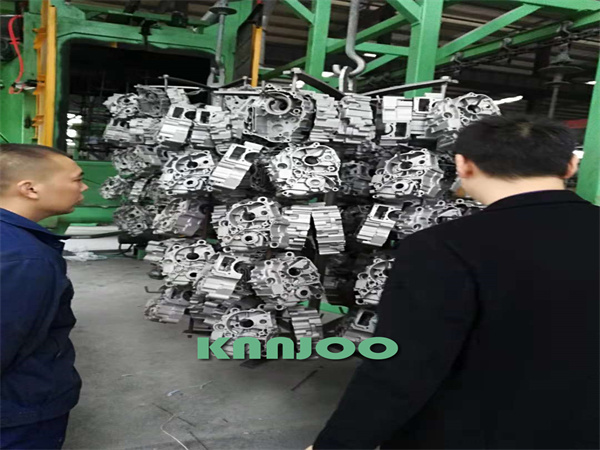
3 Aluminum Die Castings
1. Information to be provided by the customer.
2. Part dimensions: length (provide both maximum and minimum).
3. Part dimensions: width (provide both maximum and minimum).
4. Part thickness.
5. Part weight (provide both maximum and minimum).
6. Part material.
7. Pre-shot blasting processing method.
8. Requirements for surface cleanliness and roughness.
9. Production volume requirements (daily/monthly/annual output).
10. Requirements for the dust collector.
11. Dimensions of the facility (height and available space) where the equipment will be installed.
12. Any other customer requirements.
