Steel Plate Pretreatment Line (Shot Blasting – Painting – Drying)
Product IntroductionThe roller conveyor through-type shot blasting machine adopts an electrically controlled variable-speed conveying roller bed to feed steel structural parts or s
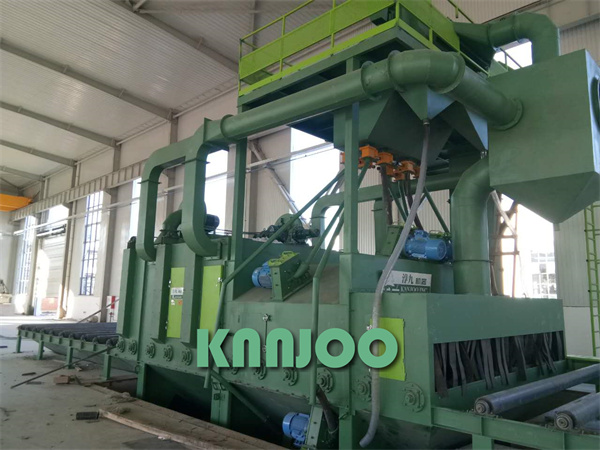
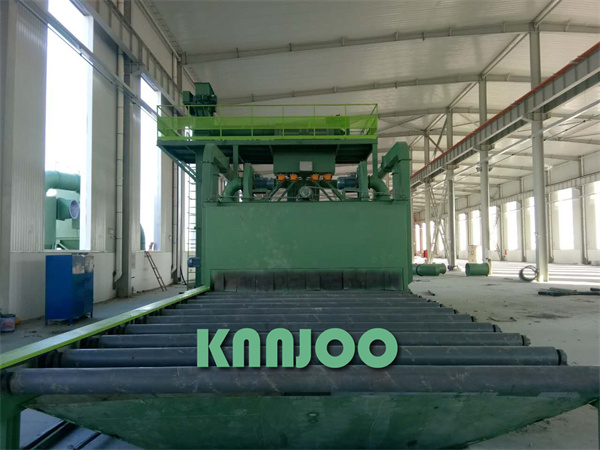
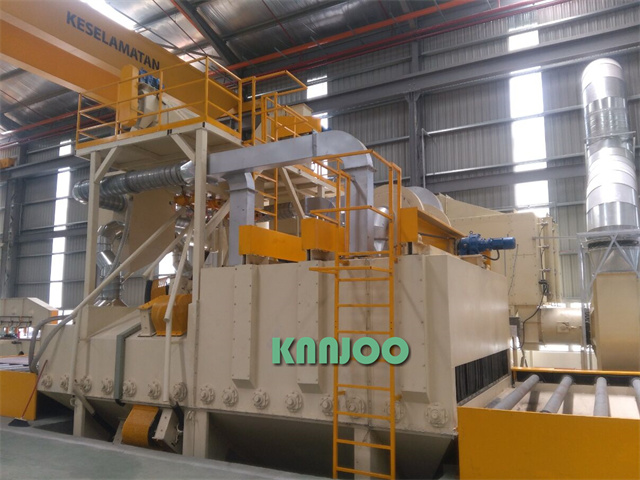
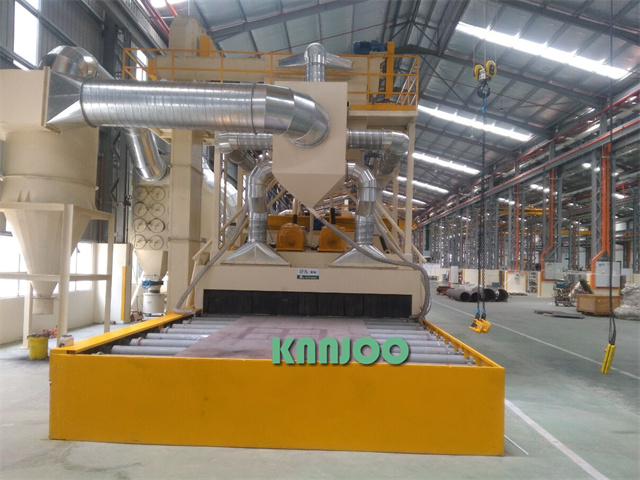
Product IntroductionThe roller conveyor through-type shot blasting machine adopts an electrically controlled variable-speed conveying roller bed to feed steel structural parts or s
Product Introduction
Applications
Descaling, cleaning, and pre-treatment are performed on various types of steel materials—such as steel plates, structural steel, steel beams, sections, steel pipes, and steel castings—using a continuous pass-through process.
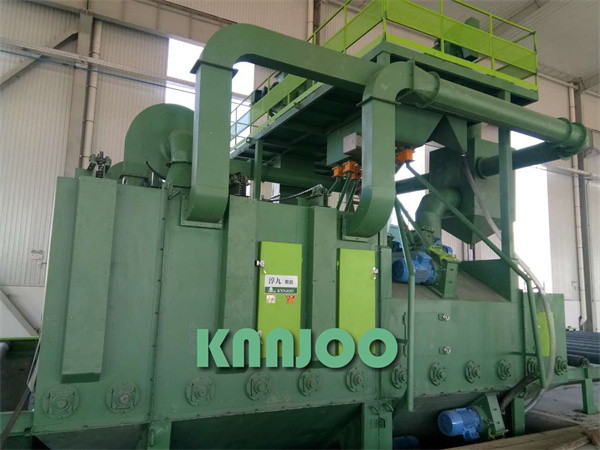
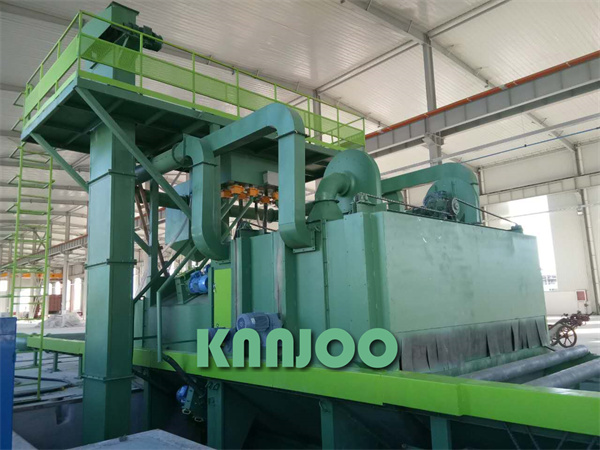
Working Principle
Roller Conveyor Pass-through Shot Blasting Machine supports non-stop continuous operation. It continuously processes various steel workpieces including steel plates, steel bars, steel beams, section steel, steel tubes and steel castings to remove mill scale, clean surfaces and conduct pretreatment. Simple operation: just load steel materials onto the machine and press the start button. After a short circulation cycle, the system automatically unloads finished workpieces, completing the whole cleaning process with all dust and residual abrasive media fully cleared.
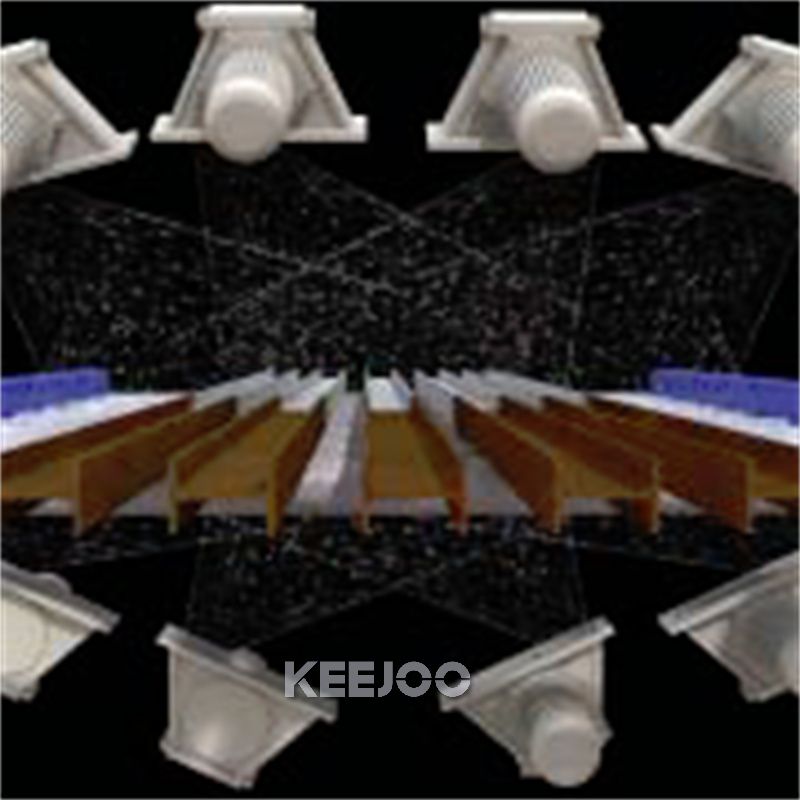
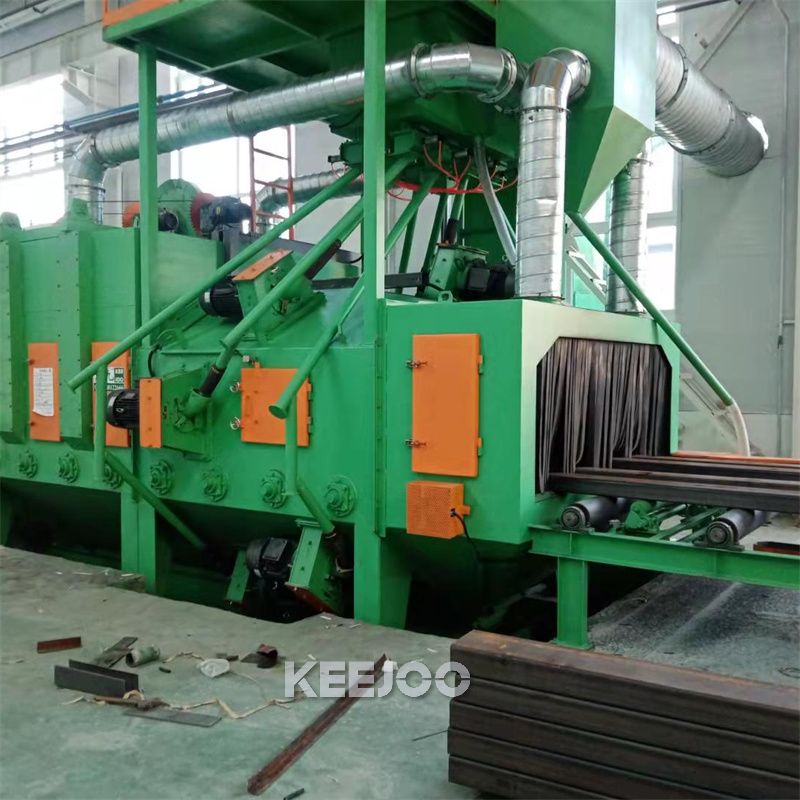
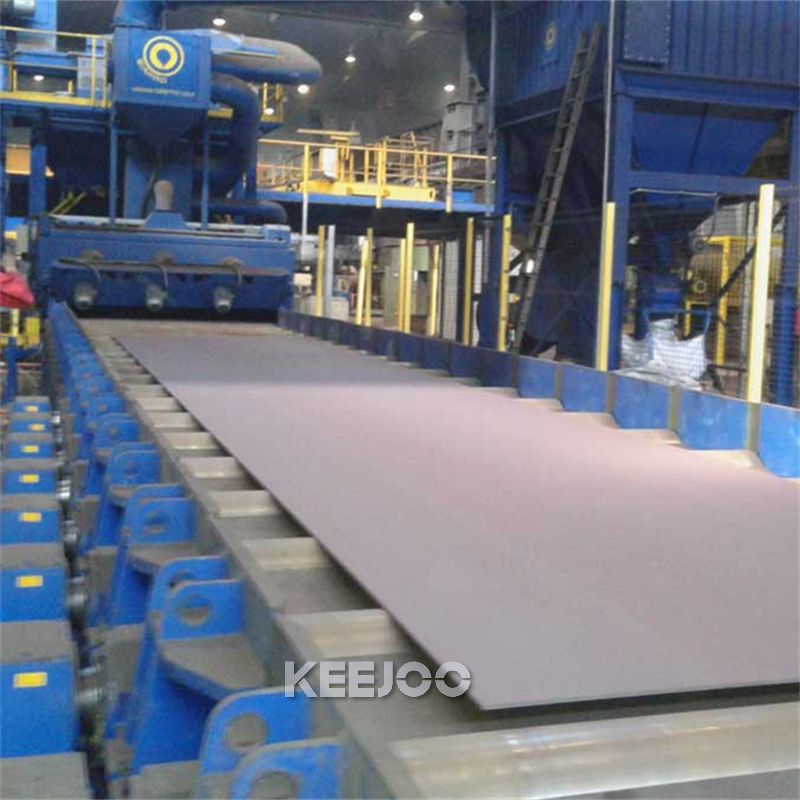
Corrosion Protection of Steel Products
The pretreatment line integrates heating (drying), shot blasting, coating and re-drying of workpieces such as steel plates, profiles, pipes and steel structural components into one automatic production line.
The pretreatment line is an ideal solution when there is a long interval of manufacturing or storage between shot blasting and final coating. To prevent re-rusting, weld primer is applied to offer corrosion resistance lasting several weeks.
Max. plate width reaches 6000 mm; conveying speed ranges from 1.0 m/min to 8.0 m/min.
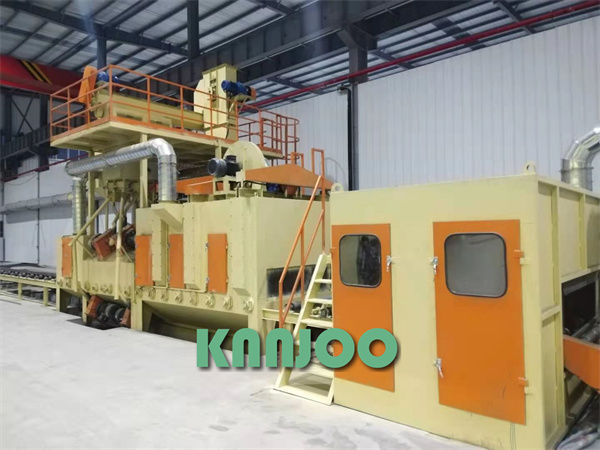
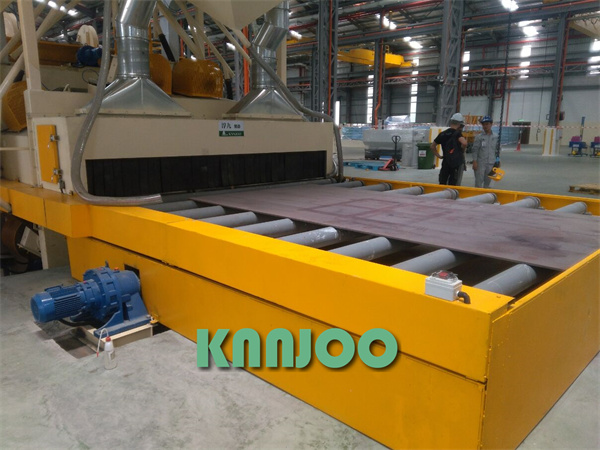
Based on different application fields of pretreatment lines, Qingdao KEEJOO Group has developed a variety of options for diverse working conditions.
Main components of the pre-treatment line
Cross-transfer conveyor, inlet roller conveyor, preheating furnace roller conveyor, roller-conveyor type shot blasting machine, shot blasting dust collector, paint booth, paint supply system, VOC system filter, VOC system (paint booth exhaust treatment system), drying chamber, slat conveyor, outlet roller conveyor, cross-transfer conveyor.
Process Flow
Roller Conveyor Inlet
The first section is the entry roller conveyor. Steel plates and profiles are delivered here and then fed into the processing line. This entry roller conveyor can be equipped with a cross-conveyor to optimize efficiency or to integrate with the logistics system.
Preheater
Used to remove residual moisture. Typically located upstream of the shot blasting machine, it ensures that workpieces are dry before entering the blasting chamber. The products are also heated to the required temperature to ensure rapid drying of the primer.
The preheater is located in front of the shot blasting machine, meaning it takes longer for the plates or profiles to reach the entrance of the spray booth.
This can balance out inevitable temperature spikes and prevent damage to the primer.
Advantages
Maximizing heat transfer to the material while minimizing gas consumption: long-tube burners—extending directly through the preheater and featuring hundreds of individual flames—impinge directly on the workpiece. This is combined with high-speed hot air circulation (approx. 250°C) driven by a high-temperature fan. The heating performance can be easily adjusted via a variable number of controllable long-tube burners, thereby avoiding the need for an excessively long preheater.
Shot blasting machine
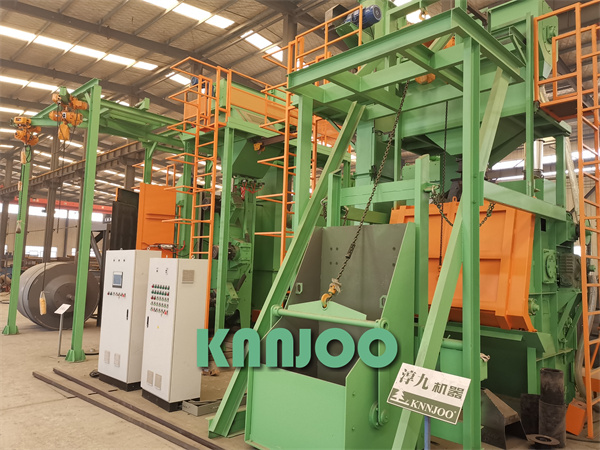
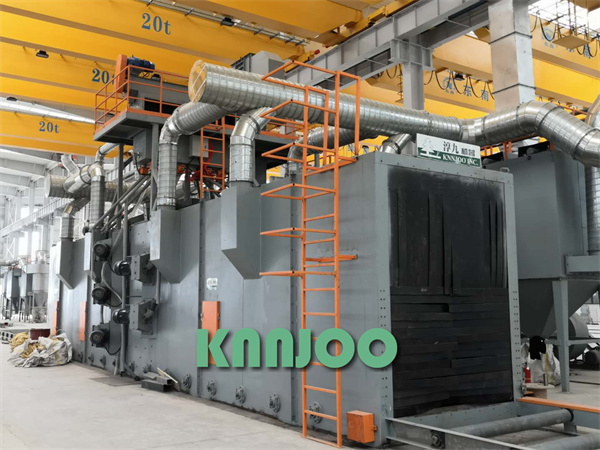
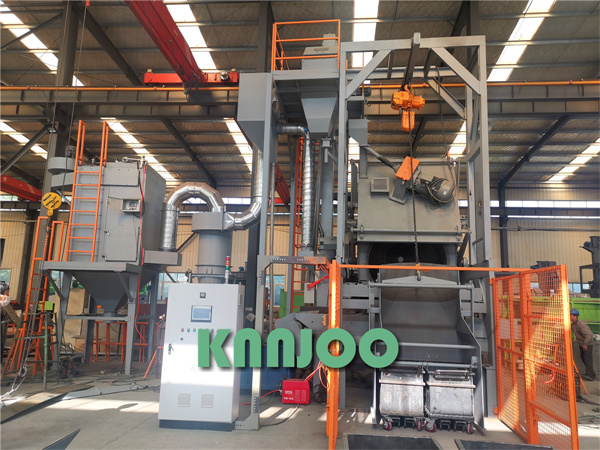
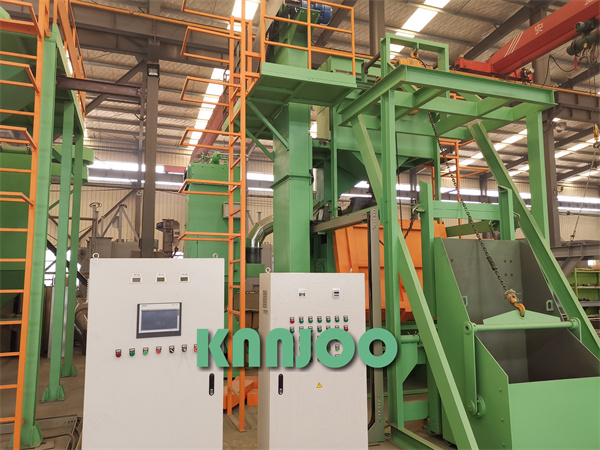
The roller conveyor shot blasting machine is a key piece of equipment in the pretreatment line. Workpieces (such as plates, profiles, or pipes) pass through the machine to remove rust and mill scale. All units are equipped with high-efficiency, easy-to-maintain HAOPIN blast wheels. The blast wheels and their positioning can be adjusted according to specific requirements, enabling thorough cleaning of the workpieces through a safe process and ensuring a surface finish that meets the internationally recognized ISO 8501-1 preparation standards.
For high-level corrosion protection, abrasive blast cleaning to preparation grade Sa 2.5 is typically required. In some cases, Sa 3 may be necessary, which requires a significant reduction in operating speed (by approximately 50%).
Round steel shot is commonly used to achieve a surface roughness of approximately Rz 40–80 μm.
Shot Blasting and Coating
Qingdao KEEJOO Group has developed a comprehensive range of shot blasting machines for pre-treatment lines, all of which can be seamlessly integrated into customized production lines.
G-Type Roller Conveyor Shot Blasting Machine
This versatile machine, equipped with straight rollers, handles sheet metal and profiles and is primarily used in the steel structure or steel fabrication industries.
HD-Type Roller Conveyor Shot Blasting Machine
This high-performance machine features angled blast wheels, offers high feed speeds and extended maintenance intervals, and is designed for the steel structure and steel processing industries to handle metal plates, pipes, and structural steel components.
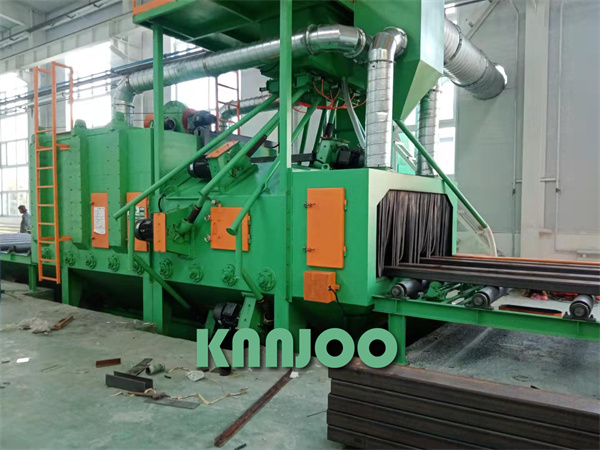
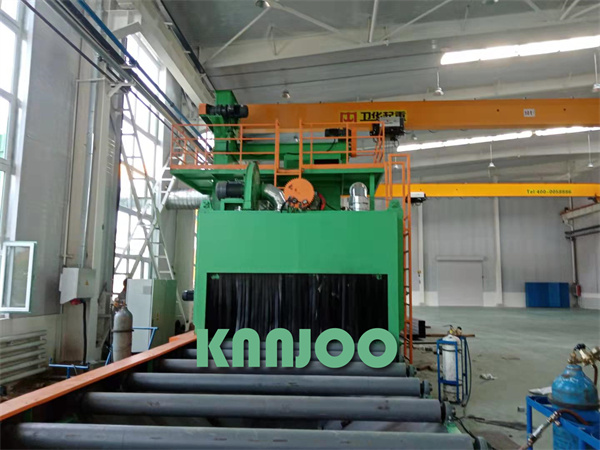
S-type roller conveyor shot blasting machine
This equipment is specifically designed as a flat plate shot blasting machine for use in large shipyards or steel rolling mills where maximum blasting performance and ease of maintenance are absolute must-have features.
Sheets are available in widths up to 5000mm and throughput speeds range from 1.0 m/min to 8.0 m/min.
Spraying system
Due to the often lengthy manufacturing or storage periods between shot blasting and the final coating application, workpieces are coated in a spray booth with a fast-drying, temporary anti-corrosion coating using an airless spray process (with a coating thickness of approximately 15–25 μm).
We use specially designed, high-capacity airless spray pumps. The high-displacement airless spray pumps ensure a lower pump frequency, thereby minimizing wear on the sealing components.
This coating represents the most expensive sub-process within the entire anti-corrosion series to date; however, its ability to precisely control the coating process can generate six-figure annual savings for the main anti-corrosion line.
Even a slight reduction in coating thickness tolerance translates into significant savings in coating material usage. Chunjiu spraying systems can achieve an incredible tolerance of 2 μm.
Workpiece identification
The operator selects the correct settings for the workpiece (pre-programmed for specific customers). This determines whether the spray-drawing process or the push-feed process is better suited to the specific type of workpiece. The workpiece is then identified by a reflective light sensor that oscillates in tandem with the spray bridge. Simultaneously, the height of the workpiece is measured using a high-resolution horizontal light curtain.
Unlike other systems, the drive mechanisms for the spray bridge and the workpiece identification sensor are located in the clean zone, ahead of the actual spray booth. This ensures that the sensors do not become contaminated by overspray over time and that their functionality remains unimpaired.
Spraying Technology
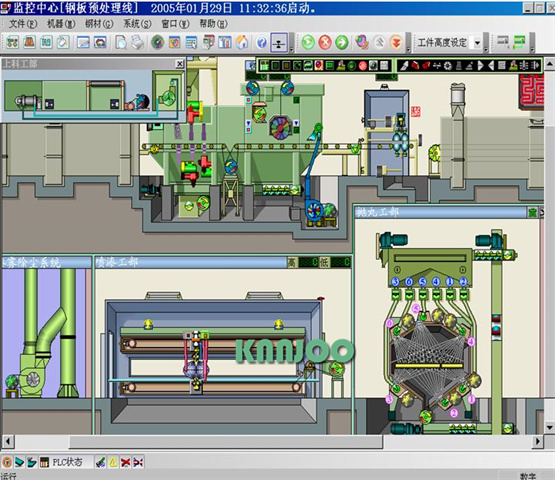
Data identifying the workpiece (position, width, height, etc.) is stored in the spraying system's PLC. Based on this intelligent workpiece recognition technology, various spraying programs can be utilized.
This is the only way to ensure extremely tight tolerances regarding coating thickness uniformity.
Coating and Drying
Qingdao KEEJOO Group employs a linear drive system featuring servo motors and toothed belts for the reciprocating mechanism. This minimizes the wear typically associated with simpler systems—such as those using V-rollers moving along extruded profiles driven by chains. KEEJOO’s hardened support rollers travel along hardened, precision-ground guide rails. A key advantage of positioning this drive mechanism upstream of the spray booth is that overspray does not contaminate the guide rails.
In Qingdao KEEJOO Group's high-performance systems, the upper and lower spray bridges are typically equipped with four nozzles each to cover a wide spraying area. These spray bridges can move at speeds of up to 2 meters per second, braking at the reversal point before accelerating in the opposite direction—a cycle that typically operates 24 hours a day.
Handling overspray
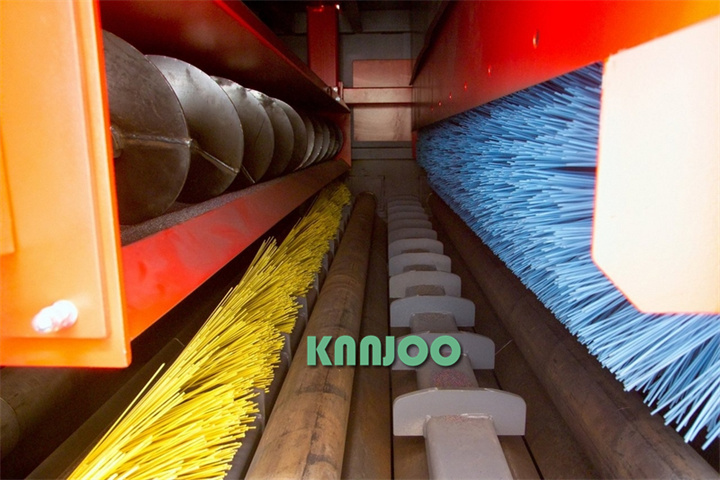
Qingdao KEEJOO Group utilizes a spray booth design where the vibratory mechanism is positioned upstream of the booth itself. Consequently, the booth structure consists primarily of smooth, flat walls. The interior surfaces are fully lined with a Teflon film, allowing overspray—once dry—to be easily removed. Depending on the equipment's dimensions, overspray can be extracted from one or both sides via Teflon-coated pre-filters. This innovative system eliminates the need for prolonged equipment downtime during wall cleaning.
This configuration ensures that only residual (largely dry) coating dust enters the filtration system. The system employs specialized Teflon-coated filter cartridges that guarantee effective, long-term dust removal from the exhaust air, achieving residual dust levels of ≤ 2 mg/m³.
When solvent-based coatings are used, the resulting gaseous emissions are not captured by the dust filtration system. In such cases, thermal, catalytic, or activated carbon filtration systems (VOC systems) are employed.
Drying Chamber and Plate Conveyor
Steel plates and profiles that have undergone anti-corrosion treatment are continuously dried here. The drying chamber can be heated using waste heat from the pre-heater, enabling rapid drying even for coatings with long drying times (such as water-based coatings). High-volume air circulation further accelerates the drying process. If the pre-heater is not required year-round, a standalone heating system can be used as an alternative or supplementary heat source.
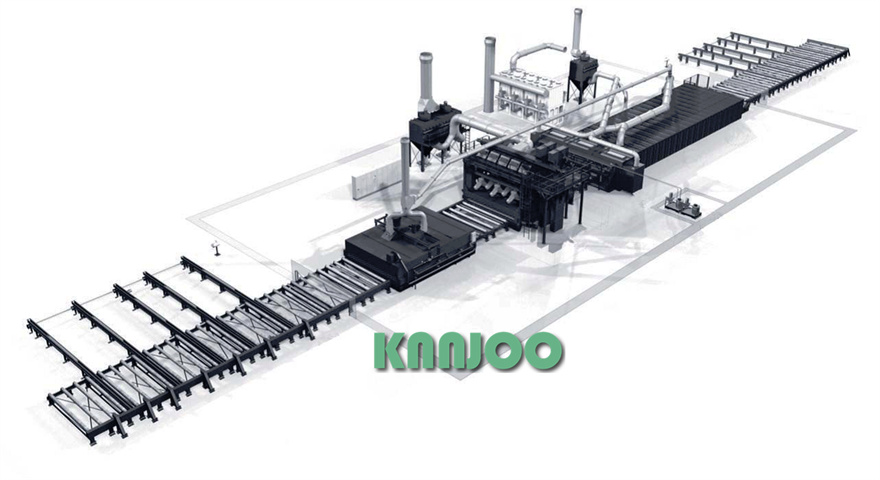
Workpieces are transported through the drying chamber via a slat conveyor. Maximizing the distance between the spraying zone and the slat conveyor minimizes unavoidable contamination caused by overspray. To prevent the sheets from bending, a lifting roller conveyor is positioned upstream to compensate for height differences and ensure a smooth transfer to the cross-conveyor. The sheets rest solely on the support points of the cross-conveyor, resulting in minimal contact with the workpieces; consequently, the wet primer coating remains virtually undisturbed.
The length of the drying chamber varies depending on the type of coating, coating thickness, and throughput speed.
Selecting the right drive is crucial, as the loads involved can be very high. The correct drive shaft arrangement, drive system, and gear ratio will ensure the smooth, uniform operation of the slat conveyor.
Exit roller conveyor
The final section is the exit roller conveyor, where the pre-treated steel plates and profiles are discharged.
The roller conveyor exit can be equipped with a transverse conveyor to optimize efficiency or connect to a logistics system.
Qingdao KEEJOO Group Steel Plate Shot Blasting Machine: Specifications and Configuration List | ||||||||
| No. | Name | Roller conveyor type shot blasting machine | ||||||
| 1 | Model | KJ-104011-4 | KJ-104511-6 | KJ-253015-12 | KJ-408011-10 | |||
| 2 | Application | Shot blasting and derusting for steel plates, medium-to-heavy plates, large workpieces, and welded structural steel components. | ||||||
| 3 | Blast wheel type | Direct-drive/Belt-drive Type | ||||||
| 4 | No. of blast wheel | 4个 | 6个 | 12个 | 10个 | |||
| 5 | Blast wheel power | 11KW | 11KW | 15KW | 11KW | |||
| 6 | Roll (roll diameter × roll spacing) mm | φ80*300 | φ80*300 | Φ180*800 | Φ121*800 | |||
| 7 | Optimal usage range | Load capacity (excluding tooling, kg) | ≤500kg/m | ≤500kg/m | ≤2000kg/m | ≤1000kg/m | ||
Individual workpiece dimensions (Width × Height, mm) | ≤800*300 | ≤800*350 | ≤2300*2800 | ≤3600*600 | ||||
| 8 | Max entrance dimensions (W × H, mm) | 1000*400 | 1000*450 | 2500*3000 | 4000*800 | |||
| 9 | Flow control valve | Semi-automatic | 4sets | 4sets | 12sets | 10sets | ||
| 10 | Dust collector | Dry-type | DC-12 | DC-18 | DC-48 | DC-48 | ||
| 11 | Airflow (m³/h) | ≤18000 | ≤18000 | ≤50000 | ≤50000 | |||
| 12 | Overall Dimensions of Main Unit (L × W × H, mm) | 8600*3900*6536 | 14600*3907*6200 | 23000×7000×8000 | 37113*5563*11513 | |||
| 13 | Total power (excluding dust collector) | 55.8KW | 55.8KW | 252.5KW | 196 | |||
| 14 | Total weight (excluding dust collector) | 15T | 20 T | 50T | 40T | |||
This machine is equipped with the HAI Ocean Surge® direct-coupled high-efficiency blast wheel (German design with independent patents, Patent No.: ZL 2015 2 0702933.5).
The blast wheel is the heart of a shot blasting machine, and its design determines the performance of the entire system. The HAI Pengpai® blast wheel comes as standard equipment, delivering superior blasting performance. Available in a variety of sizes and materials, the H-series blast wheel ensures flexibility across diverse manufacturing processes. Its key advantages include enhanced blasting performance, reduced abrasive consumption, significantly extended equipment uptime, and effective noise reduction.The casing is lined with curved, multi-layer labyrinth-style sealing plates; the hot zone features a thickness of 70mm, ensuring excellent sealing performance and a uniform distribution of the projected abrasive media over an expanded coverage area. The internal design allows for the adjustment of abrasive trajectories, thereby enhancing blasting efficiency and minimizing self-wear. Additionally, a specialized dynamic design boosts efficiency by 30% compared to standard blast wheels.


Selected Cases of KEEJOO Roller Conveyor Steel Shot Blasting Machine
245 sets of section steel shot blasting machines manufactured for Hangxiao Steel Structure Company
16 sets of section steel shot blasting machines manufactured for Hangzhou Southeast Grid
Shanghai Guandar steel profiled steel roller conveyor shot blasting machine 2 sets
9 sets of section steel shot blasting machines manufactured for China Construction Steel Structure Tianjin Company
8 sets of through-type shot blasting machines manufactured for Shanghai Baoye Steel Structure
So far, the performance of more than 600 set-type steel pass-through shot blasting machines at home and abroad is far ahead.
......


A large listed domestic agricultural equipment group phased out its outdated shot blasting machines in the past two years and fully adopted hook-type shot blasting machines independently developed and manufactured by Qingdao KEEJOO Group. Up to now, the group has purchased a total of 58 units.........


The various shot blasting machines manufactured by Qingdao KEEJOO Group for European clients are highly acclaimed and well-received.!
Introduction to the Components of the Shot Blasting Machine
2. features a more compact footprint than traditional blast wheels, supports arbitrary installation angle arrangement, and enables far easier inspection and maintenance.
3. Constant blasting performance is maintained throughout operation, free from inconsistent and fluctuating cleaning quality seen on conventional units.
4. Blades and all wear-resistant consumables are manufactured in Taiwan via high-chromium investment precision casting, delivering outstanding abrasion resistance. Their service life ranges from 1,200 to 4,000 hours, 3–4 times longer than ordinary casting materials.
5. Blast wheel impeller: Treated with carburizing wear-resistant alloy. The impeller hub is one-time finished by high-precision CNC machining centers for ultra-high dimensional accuracy, ensuring perfect dynamic balance during high-speed rotation, low vibration, low noise and extended service life.
6. Equipped with SKF bearings imported from Sweden.
7. Fitted with genuine Siemens motors.
8. German Schenck dynamic balancing tester is applied to guarantee precise high-speed dynamic balance of impeller hubs.


1. Semi-automatic flow control system for regulating the flow of abrasive media into the blast wheel, featuring manual adjustment of the steel shot flow rate.
2. Fully sealed structural design, featuring a lockable inspection opening and equipped with two bearings.
3. A manual shut-off valve is installed above each flow valve; this can be closed to stop the flow of media from the hopper, thereby facilitating maintenance of the flow valve.
Blasting chamber

1. The shot blasting chamber is constructed from welded manganese steel.
2. Manganese steel protective plates are installed in the "hot zone" of the chamber—specifically covering three-quarters of the area directly exposed to the blast stream—to prevent steel shot from striking the chamber's outer walls; these plates are suspended for easy installation, removal, and replacement.
3. A three-layer sealing structure is installed at the top to prevent steel shot from leaking out during the blasting process.
1. The workpiece conveying system for the entire production line utilizes stepless variable-frequency speed control and consists of an input roller conveyor, a shot-blasting chamber roller conveyor, and an output roller conveyor.
2. The rollers for both the input and output roller tables are manufactured by welding heat-treated shaft ends to high-quality carbon steel seamless pipes, followed by integral machining on a lathe. Machining is performed after welding to ensure both a load-bearing capacity of 0.5 t/m and precise coaxiality.
3. The rollers within the shot blasting chamber that are subjected to the impact of the shot are all fitted with easily replaceable, wear-resistant sleeves made of special high-chromium-molybdenum iron.
4. The roller pitch is 600–800 mm, and the entire line utilizes variable-frequency speed control, enabling both high-speed and low-speed workpiece transport.


Wire mesh-belt conveyor type:
1. The system comprises dozens of transmission components, including carbon steel rollers, sprockets and chains, mesh belts, and bearings. The roller conveyor is divided into three sections: the infeed section, the shot-blasting section, and the discharge section. The rollers are constructed by precision-welding quenched-and-tempered end caps to high-quality seamless carbon steel pipes; their profiles and mounting dimensions are machined after welding to ensure compliance with load-bearing and coaxiality requirements.
2. The roller conveyors inside the blast chamber are equipped with easily replaceable wear-resistant medium-chromium cast iron sleeves. Labyrinth seals made of wear-resistant manganese steel are used at both ends of the roller shafts, completely preventing abrasive media from wearing down the bearings.
3. Utilizes imported HD wear-resistant manganese steel that has undergone solution and tempering treatments to eliminate internal residual stresses, moderately reduce the hardness of the manganese steel wire, and enhance its toughness and ductility.
4. A geared drive motor is installed on the right side of the conveyor belt and directly coupled to the drive roller, propelling both the belt and the workpieces; variable frequency speed control is employed, providing a conveying speed of 0.5–4 m/min.
5. A roller is installed under the driving shaft to serve as a guide and tensioner. When the steel mesh belt is loose, it can be tightened through this mechanism.


1. Two sets of light curtain sensing units are installed at the infeed and outfeed openings, respectively; the light curtain resolution can be selected based on workpiece size, and the units are used in pairs.
2. When a workpiece enters the shot blasting chamber, a light curtain at the inlet detects its presence, triggering a delayed start of the blast wheels. A light curtain sensor is also installed at the outlet; when the inlet and outlet sensors detect that no workpieces are passing through, the flow valve closes automatically and immediately to prevent "air blasting" (blasting without a workpiece present).

1. A mesh screen separator is connected to the elevator and positioned above the magnetic separator; fine material passes through the screen into the magnetic separator, while coarse material and impurities are conveyed by a spiral mechanism along the screen to the discharge port at the rear.
2. It is designed to finely separate usable shot, broken shot, and dust, ensuring the uniformity of the shot media.
3.Featuring a welded structure, the interior contains multiple carefully designed compartments for airflow guidance. An access door on the front allows for routine inspection and maintenance; this door is equipped with an air inlet to provide the necessary airflow for dust separation.
4. An adjustable multi-vane baffle structure is used to regulate the uniformity of the falling abrasive curtain.
5. Stationary magnets installed at both the top and bottom enable the fine separation of usable shot from broken steel shot, ensuring the consistency of the blast media.
6. A storage hopper is connected at the bottom; after separation, the usable shot flows into the hopper for storage and subsequent reuse.


Electrical control cabinet
1. Siemens PLC and touch screen
2. Siemens variable frequency drive (VFD) for speed control
3. Schneider low-voltage electrical components
4. Shot blasting time controller
5. AirTAC pneumatic components
6. Ammeter for flow monitoring
7. 1 lighting fixture
8. Dedicated constant-temperature air conditioning unit (optional)


Dust collector
Pulse-jet cleaning system
Precision filter cartridge filtration system
High-efficiency three-stage dust removal
Optimized and upgraded Donaldson (USA) dust removal technology system


Standard configuration: | ||||||||
| 1 | Electrical cabinet: This model comes standard with a cooling fan; air conditioning is available as an option. | |||||||
| 2 | Programmable Logic Controller (PLC): Siemens (other brands available as options upon customer request) | |||||||
| 3 | Touchscreen: Siemens (other brands available as options upon customer request) | |||||||
| 4 | Variable Frequency Drive (VFD): Inovance (China) — (Specific brands can be designated upon customer request; we recommend our domestic brand, as its quality is on par with or superior to Siemens.) | |||||||
| 5 | Power supply voltage: AC 380V, three-phase five-wire system | |||||||
| 6 | Low-voltage electrical components: Schneider (other brands available upon customer request) | |||||||
| 7 | Pneumatic components: ARITAC series (other brands available upon customer request) | |||||||
| 8 | Wires and cables | |||||||
| 9 | Qingdao KEEJOO Group can also customize various non-standard shot blasting machines according to your requirements. | |||||||
Qingdao KEEJOO Group Roller Conveyor Shot Blasting Machine: Specifications and Configuration List | ||||||||
| No. | Name | Roller conveyor type shot blasting machine | ||||||
| 1 | Model | KJ-2230P15-16 | KJ-2028P11-14 | |||||
| 2 | Sorting configuration | Air separation | ||||||
| 3 | Application | Shot blasting and derusting of large workpieces, profiles, and welded steel structures. | ||||||
| 4 | Blast wheel type | German-style High-Performance HAI Shot Blasting Unit | American-style Pan-bagnat | |||||
| 5 | No. of blast wheel | 16 sets | ||||||
| 6 | Blast wheel motor power | 11KW | ||||||
| 7 | Roller spacing | φ280*1000 | ||||||
| 8 | Load-bearing capacity (excluding fixtures) | ≤5吨 | ||||||
| 9 | Dimensions of a single workpiece (width × height × length) | ≤2200*3000*14600mm | ||||||
| 10 | Max entrance dimensions (width x height) in mm | 2400*3000mm | ||||||
| 11 | Semi-automatic flow valve | 16 Sets | ||||||
| 12 | Fully automatic flow valve | Optional | ||||||
| 13 | Dry dust collector | QL-48 Filter Element (37 kW) | ||||||
| 14 | Wet dust collector | Optional | ||||||
| 15 | Airflow (m³/h) | ≤38000 | ||||||
Qingdao KEEJOO Group comprises three subsidiaries and an international business division, standing as a leading Asian manufacturer of high-end shot blasting and peening machinery, as well as environmental protection equipment. The company has introduced and developed over 100 types of shot blasting and peening machines for cleaning and surface strengthening; more than 20 of these products have filled gaps in the domestic market. Its products are utilized by renowned enterprises such as ThyssenKrupp, Siemens, FAW-Volkswagen, Cummins Engine, Dongfeng Motor, Weichai Power, Sinotruk (Jinan), China High-Speed Rail, Bombardier, Chery Automobile, North Benz, Hitachi Nuclear, Sany Heavy Industry, Fuji Heavy Industries, Tangshan Gear, Aisin (Japan), Alstom (France), Doosan (South Korea), and Caterpillar (USA). With exports reaching 49 countries—including Spain, France, the USA, South Korea, Japan, Singapore, Australia, and Russia—the company enjoys an excellent global and domestic reputation.
In recent years, by introducing and assimilating advanced technologies from companies such as Germany's AGTOS, KEEJOO has achieved a world-class level in product design. The company's high-efficiency, direct-drive shot blasting wheel—representing the best of Asian technology in this field—has garnered praise and recommendations from customers in Europe and the Americas.

The company was among the first in China's casting machinery industry to obtain ISO 9001, German TÜV, EU CE, French BV, and North American FCC certifications, as well as import-export rights. By introducing and further optimizing technologies from Germany, the United States, and other regions, the company has enhanced product performance and accelerated the phase-out of outdated technologies, earning recognition from new and existing customers worldwide.

Next step?
Spare Parts and Consumables
We provide high-quality replacement parts with extended service lives. As a major supplier of spare parts in the industry, we offer rapid global delivery, helping you avoid the need for large inventories and preventing production downtime.


High-end shot blasting unit manufacturing workshop
Equipment Upgrade
We will keep you updated on the latest technology upgrades so you can decide whether to incorporate them into your equipment's routine maintenance to ensure optimal service life.
Equipment Modernization and Upgrading